Global Unions, Local Power: The New Spirit of Transnational Labor Organizing by Jamie K. McCallum
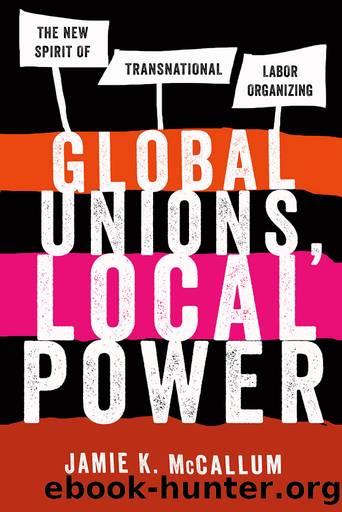
Author:Jamie K. McCallum [McCallum, Jamie K.]
Language: eng
Format: epub
Tags: Labor, Globalization, Labor & Industrial Relations, Political Science, Business & Economics, General
ISBN: 9780801469473
Google: pcemAQAAQBAJ
Publisher: Cornell University Press
Published: 2013-10-17T09:38:45+00:00
Labor Transnationalism Then and Now in South Africa
South African labor history is rich and closely tied to the story of the nation as it looks today. Throughout that history we can identify three moments of labor transnationalism, which I refer to as communist/syndicalist, social movement, and institutional to identify the dominant influences in each period.2 The first, roughly from the early 1900s to 1960, refers to the period of worker organization that was influenced by American, Australian, British, and Scottish trade union traditions. The second period, from 1960 to 1994, largely reflects the deep analysis done by South African labor scholars on social movement unionism, a brand of militant community-based activism so fierce it has its own acronym, SMU. However, the most important point of departure for our purposes is the transition to the next phase, which takes us to the present, called âinstitutional internationalism,â and in my opinion it is representative of what is ânewâ about labor transnationalism, especially in South Africa. This is an important distinction since what is commonly referred to as ânewâ by South Africa scholarsâgrassroots or proletarian internationalismâis actually more indicative of the âoldâ models described earlier (see chapter 1). Institutional internationalism refers to numerous collaborative efforts by various unions and nonunion labor organizations but most significantly the case study under examination here.3
Central to the campaign against Group 4 Securicor (G4S)âbecause it helps explain what the SEIU and UNI were doing in South Africa in the first placeâis the demobilization of one of historyâs most audacious union movements. Why did the South African trade unions become more quiescent? As a starting point, it makes sense to consider some of the phenomena that explain the same historical trends in other labor movementsâinstitutionalization, bureaucratization, corporatismâas an antecedent to todayâs transnational activism.
Download
This site does not store any files on its server. We only index and link to content provided by other sites. Please contact the content providers to delete copyright contents if any and email us, we'll remove relevant links or contents immediately.
The Secret History by Donna Tartt(19088)
The Social Justice Warrior Handbook by Lisa De Pasquale(12190)
Thirteen Reasons Why by Jay Asher(8910)
This Is How You Lose Her by Junot Diaz(6887)
Weapons of Math Destruction by Cathy O'Neil(6280)
Zero to One by Peter Thiel(5802)
Beartown by Fredrik Backman(5754)
The Myth of the Strong Leader by Archie Brown(5507)
The Fire Next Time by James Baldwin(5446)
How Democracies Die by Steven Levitsky & Daniel Ziblatt(5219)
Promise Me, Dad by Joe Biden(5153)
Stone's Rules by Roger Stone(5088)
A Higher Loyalty: Truth, Lies, and Leadership by James Comey(4964)
100 Deadly Skills by Clint Emerson(4925)
Rise and Kill First by Ronen Bergman(4789)
Secrecy World by Jake Bernstein(4753)
The David Icke Guide to the Global Conspiracy (and how to end it) by David Icke(4720)
The Farm by Tom Rob Smith(4513)
The Doomsday Machine by Daniel Ellsberg(4490)
